
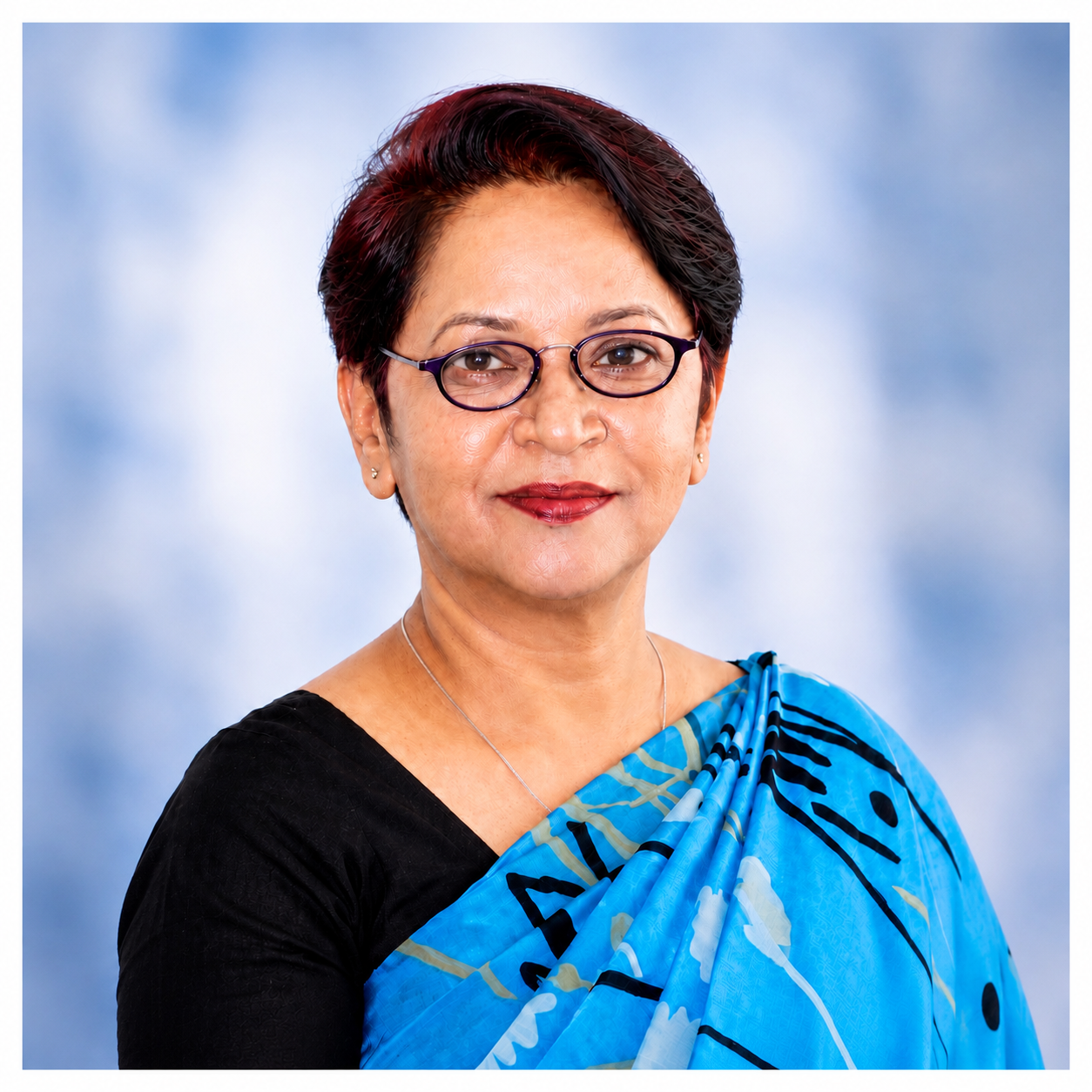
Professor Dr. Sabina Yeasmin is a distinguished academic, researcher, and higher education leader with more than three decades of experience in teaching, research, academic administration, institutional governance, and policy development. She currently serves as Professor of Home Economics at Bangladesh Open University (BOU) and previously served as Dean of the Open School, where she provided strategic leadership in academic planning, curriculum innovation, quality assurance, digital transformation, and institutional development.
Throughout her career, she has played a pivotal role in advancing Open and Distance Learning (ODL), promoting technology-enhanced education, and strengthening institutional capacity through evidence-based academic leadership. She has successfully led and implemented several nationally and internationally funded initiatives supported by the European Union (Erasmus+), the World Bank, the Commonwealth of Learning (COL), and the Commonwealth Educational Media Centre for Asia (CEMCA). These initiatives have focused on gender equality, quality assurance, Open Educational Resources (OER), faculty development, youth empowerment, entrepreneurship, and inclusive education.
Professor Yeasmin has an established record of scholarly contributions through peer-reviewed publications, books, conference presentations, postgraduate supervision, editorial leadership, and peer-review activities. Her research interests include higher education, gender and development, food security, sustainable entrepreneurship, educational technology, disaster risk reduction, and social development. She is widely recognized for fostering interdisciplinary collaboration, promoting academic excellence, and strengthening international partnerships in higher education.
Her leadership philosophy is grounded in academic integrity, innovation, inclusiveness, and service to society. She remains committed to strengthening institutional governance, enhancing research excellence, expanding international collaboration, and contributing to the sustainable development of higher education in Bangladesh and beyond.
|
Degree Title |
Institute |
Passing Year |
|
Doctor of Philosophy (PhD)
|
Indira Gandhi National Open University (IGNOU), New Delhi, India
|
2016 |
|
Master of Philosophy (MPhil) |
University of Dhaka, Bangladesh |
2012 |
|
Master of Science (MSc) in Home Economics (First Class) |
University of Dhaka, Bangladesh |
1993 |
|
Bachelor of Science (Hons) in Home Economics (First Class)
|
University of Dhaka, Bangladesh |
1991 |
|
Certificate in Designing and Facilitating e-Learning |
Open Polytechnic of New Zealand
|
2012-2013 |
|
Certificate in Instructional Design for Open and Distance Learning |
International Extension College (IEC), Cambridge, United Kingdom
|
1998 |
A. International Peer-Reviewed Journal Articles (Scopus / ESCI Indexed)
1. Hossain, M. S., Fahad, S., Sarker, T., Rabbany, M. G., Yeasmin, S., & Roy, R. (2026). Pesticide handling practices, occupational risks, and health expenses among Bangladeshi smallholder vegetable farmers. Journal of Agriculture and Food Research, 26, Article 102727. https://doi.org/10.1016/j.jafr.2026.102727 [Elsevier | Scopus Indexed]
2. Hossain, S. A., Yeasmin, S., & Sultana, B. (2026). Factors influencing e-commerce shopping adoption: Empirical evidence from consumers in Bangladesh. Research Journal in Business and Economics, 4(1). https://doi.org/10.61424/rjbe.v4i1.742
3. Sarker, T., Roy, R., Yeasmin, S., Rabbany, M. G., & Asaduzzaman, M. (2025). Technology adoption intention and sustainable entrepreneurship ability of rural women in Bangladesh. Business Strategy & Development. https://doi.org/10.1002/bsd2.v8.1 [ESCI | Scopus Indexed]
4. Sarker, T., Roy, R., Yeasmin, S., & Asaduzzaman, M. (2024). Enhancing women's empowerment as an effective strategy to improve food security in rural Bangladesh: A pathway to achieving SDG 2. Frontiers in Sustainable Food Systems, 8, Article 1436949. https://doi.org/10.3389/fsufs.2024.1436949 [Scopus Indexed]
5. Yeasmin, S., & Yasmin, S. (2020). Women empowerment through entrepreneurship development in Bangladesh. Asian Journal of Science and Business, 4(5), 37–49.
6. Yeasmin, S., Rahman, M., & Hossain, K. Μ. (2019). Evaluating the quality of the blended B.Ed. programme: A case study of Bangladesh Open University. DEStech Transactions on Social Science, Education and Human Science. https://doi.org/10.12783/dtssehs/3211
7. Yeasmin, S., & Mahmud, D. (2019). Acquiring scientific and technological proficiency: The state of science education in Bangladesh. Asian Journal of Humanity, Art and Literature, 5(3), 111–126.
8. Yeasmin, S., & Mahmud, D. (2019). ICT culture for quality education: An Open and Distance Learning perspective in Bangladesh. International Journal of Science and Business, 3(1), 167–174.
9. Yeasmin, S., & Murthy, C. R. K. (2015). Learners' attributes and perceptions of the effectiveness of gender-sensitive and gender-responsive texts and tutorials in the Open School of Bangladesh Open University. COMOSA Journal of Open Schooling, 5(2), 133–140.
10. Yeasmin, S. (2015). Making Open and Distance Learning inclusive for persons with disabilities in Bangladesh. COMOSA Journal of Open Schooling, 5(1), 30–44.
11. Yeasmin, S., & Murthy, C. R. K. (2015). Emerging Strategies for Attraction and Retention of Young Teachers at Private Universities in Bangladesh. International Journal of Eduquest (West Bengal, India), 4(2).
12. Yeasmin, S., & Murthy, C. R. K. (2015). Study Habits and Demographic Characteristics Learners’ Attributes and Perceptions on Effectiveness of Gender-sensitive and Responsive Texts and Tutorials of the Open School of Bangladesh Open University. Turkish International Women Online Journal of Distance Education (WOJDE), 4(1). ISSN: 2147-0367.
13. Yeasmin, S., Rahman, K. F., & Rosfashida, S. (2014). A Comparative Study of Student Support Services of Bangladesh Open University and Open University of Malaysia. Indian Journal of Open Learning (IGNOU, India), 23(1&2), 3-16.
14. Yeasmin, S., & Murthy, C. R. K. (2014). Gender-Sensitivity Analysis of the Text-Materials used in the Open Non-formal Education (ONFE) Programme run by the NGOs in Bangladesh. Turkish International Women Online Journal of Distance Education (WOJDE), 3(2). ISSN: 2147-0367.
15. Yeasmin, S. (2013). Learners’ preparedness for Digital Learning Materials (DLMs) as a supplement to self-learning materials at the Open School of Bangladesh Open University. Universal Journal of Communications and Network (USA), 1(3), 105–109. https://doi.org/10.13189/ujcn.2013.010304
16. Yeasmin, S., Rahman, M., & Murthy, C. R. K. (2012). Gender analysis of selected ICT-based learning materials used in continuing education programmes implemented by NGOs in Bangladesh. Journal of Research in Gender Studies (USA), 2(2), 64–71.
17. Yeasmin, S., Rahman, M., & Murthy, C. R. K. (2011). Gender responsiveness of tutorial sessions in Open School programmes at Bangladesh Open University. Journal of Research in Gender Studies (USA), 2(1), 148–156.
18. Yeasmin, S., & Murthy, C. R. K. (2011). Developing a conceptual framework for revising self-learning materials of the Open School of Bangladesh Open University in a digital environment. Turkish Online Journal of Distance Education (TOJDE), 12(4).
19. Yeasmin, S., & Dhar, M. (2010). Quality assurance in distance education: Problems and challenges. International Journal on New Trends in Education and Their Implications (IJONTE), 1(2).
20. Yeasmin, S., & Islam, M. N. (2010). Evaluating the effectiveness of distance education through a modified summative evaluation approach: A case study. International Journal on New Trends in Education and Their Implications (IJONTE), 1(1).
B. National Peer-Reviewed Journal Articles
1. Akhter, S. S., Sattar, M. A., Yeasmin, S., & Dhar, U. (2025). Household waste management in Bangladesh: An analysis of Ward No. 35 of Gazipur City Corporation. BJFT Journal of Fashion Technology, 9, Article 6683. https://doi.org/10.59383/bjft.2025.9005
2. Sarker, T., Yeasmin, S. (2024). Impact of social capital and innovation on women’s entrepreneurship and poverty alleviation in rural Bangladesh. International Journal of Natural and Social Sciences, 11(1), 27–38. https://doi.org/10.5281/zenodo.12593137
3. Yeasmin, S., & Taher, S. (2022). The need for sexual knowledge awareness among adolescents during puberty: An empirical study. Bangladesh Open University Journal of Open School, 8–11(1), 169–180.
4. Yeasmin, S. (2021). Supporting distance learners through mobile applications: A case study of Bangladesh Open University. The National University Journal of Humanities, Social Sciences and Business Studies, 6–7(2–1), 1–9.
5. Yeasmin, S. (2021). Harnessing openness in teaching and learning: The role of Open Educational Resources. Bangladesh Open University Journal of Open School, 7(1), 1–10.
6. Yeasmin, S., & Salim, A. A. (2021). Heritage artefacts and domestic interiors in ancient Bengal: A historical analysis. Bangladesh Open University Journal of Open School, 7(2), 135–156.
7. Yeasmin, S. (2019). Disability inclusion in Bangladesh: A human rights perspective. Bangladesh Open University Journal of Open School, 6(1), 1–16.
8. Yeasmin, S., & Rahman, K. F. (2018). Food security and its multidimensional nexus: Availability, accessibility, and food consumption in Dhaka City. Bangladesh Open University Journal of Agriculture & Rural Development, 9(1–2), 87–100.
9. Yeasmin, S. (2017). Drug addiction in Bangladesh: Causes and consequences. Bangladesh Open University Journal of Open School, 5(1), 107–124.
10. Yeasmin, S. (2016). The role of Open and Distance Learning in supporting basic education for vulnerable groups in Bangladesh: An exploratory study. Journal of Bangladesh Open University, 3(1), 1–16.
11. Yeasmin, S., & Satter, M. (2015). Human Security and Climate Change induced Disaster: Bangladesh Perspective. NU Journal of Humanities, Social Science & Business Studies, 2(1), 13-30.
12. Yeasmin, S., & Rahman, K. F. (2014). Village Tourism as Sustainable Development Alternative: Empirical Evidence from Mawlynnong, the Cleanest Village in Asia. ASA University Review, 8(14), 129-141.
13. Yeasmin, S. (2014). Regional integration in South Asia through trade facilitation: Challenges and opportunities. ASA University Review, 8(15), 19–38.
14. Yeasmin, S. (2013). Factors influencing the acceptance of Open and Distance Learning: The case of Bangladesh Open University. NAEM Journal, 8(16), 131–144.
15. Yeasmin, S. (2013). Rainwater harvesting in Dhaka City: Prospects and challenges. ASA University Review, 7(12), 143–150.
16. Yeasmin, S. (2013). E-learning in Bangladesh: Challenges and opportunities. BRA Journal for Classroom Teaching, 4(1), 21–25.
17. Yeasmin, S. (2013). Climate change governance for sustainable development in Bangladesh. BPDM Journal of Research, 1(1), 72–79.
18. Yeasmin, S. (2012). Paulo Freire’s concept of critical literacy: Its relevance to Bangladesh. Bangladesh Education Journal, 11(2), 1–15.
19. Yeasmin, S. (2012). Triangulation as a research methodology in social science research. BUP Journal, 1(1), 154–163.
20. Yeasmin, S., & Rahman, K. F. (2012). Implementation of press laws for the protection of human rights in Bangladesh. Society & Change, 6(1), 1–28.
21. Yeasmin, S. (2012). Rise of elites versus the subaltern struggle for survival: A Bangladesh perspective. Samaj Nirikkhon, 121, 41–50.
22. Yeasmin, S. (2011). Inclusion of persons with disabilities in Open and Distance Learning at Bangladesh Open University. Journal of Open School, 4(1–2), 63–72.
23. Yeasmin, S. (2009). Changing status of women and their emancipation: The Bangladesh scenario. Journal of Prime University, 3(1), 87–107.
24. Yeasmin, S., & Islam, M. N. (2009). Evaluating the effectiveness of distance education through modified formative evaluation: A case study. Journal of Open School, 3(1–2), 9–16.
25. Yeasmin, S., & Islam, M. N. (2005). Assignment-based assessment in the examination system of higher education. Journal of Scientific and Technological Research (JSTR), 1, 75–82.
• Open and Distance Learning (ODL): Curriculum Development, Instructional Design, Self-Learning Materials (SLM), Digital Learning and e-Learning, Open Educational Resources (OER), Quality Assurance in Higher Education.
• Gender and Social Development: Gender Equality and Women’s Empowerment, Child Development, Girls’ Leadership, Disability and Inclusive Education, Entrepreneurship Development, Family and Community Development.
• Food, Nutrition and Sustainable Development: Food and Nutritional Security, Human Security, Social Protection and Social Security, Climate Change and Disaster Risk Reduction, Sustainable Development Goals (SDGs).
• Research Methodology: Quantitative Research, Qualitative Research, Mixed-Methods Research, Research Design, Monitoring and Evaluation, Data Analysis.
Download the complete academic curriculum vitae.